 English
 Español
 Português


Machu Picchu history begins in the mid-15th century, when the Inca ruler Pachacuti ordered this citadel built high in the mountains, most likely as a royal estate and religious center. It was lived in for only a few decades, abandoned around the time of the Spanish conquest and made known worldwide by Hiram Bingham in 1911.
We are local guides based in Cusco, and we tell this story almost every day, standing in front of the same walls. In this guide we explain who built Machu Picchu, what it was for, what its name means, how it was built and which temples to look for, based on what historians know today and without made-up legends.

Machu Picchu History: Who Built It and When?
According to historians, Machu Picchu was built around the mid-15th century, during the reign of the Inca Pachacuti (Pachacútec in Spanish), the ruler who turned Cusco into the capital of a great empire. There is no document recording the exact date of construction, so the precise years you may see online should be taken with caution.
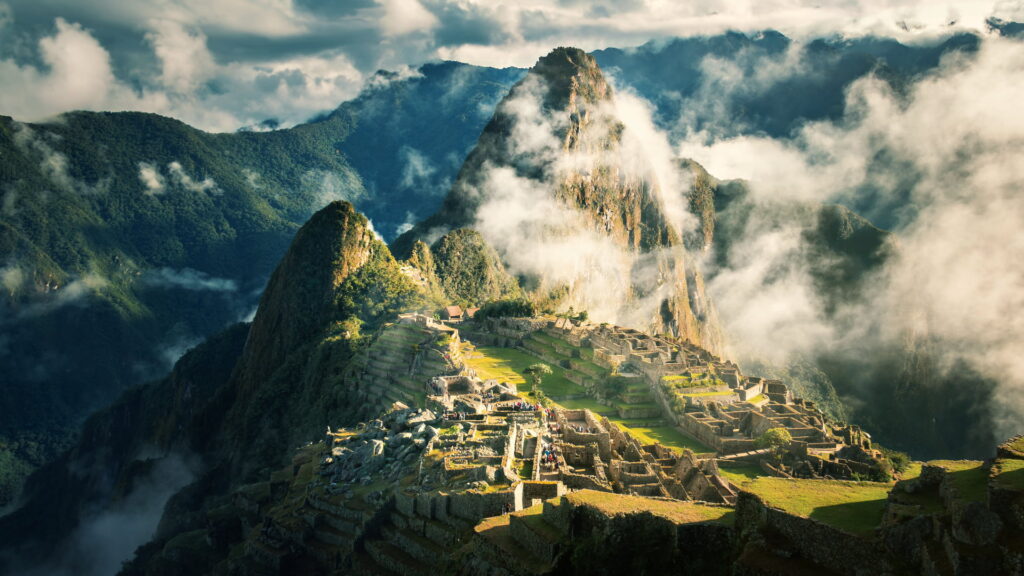
Pachacuti pushed Inca expansion far beyond the Cusco valley and ordered large-scale works across the region. Machu Picchu belongs to that golden moment: a citadel set on a mountain ridge at about 2,430 m (7,970 ft), between Machu Picchu Mountain and Huayna Picchu, with the Urubamba River far below. To learn more about this ruler, read our post on Pachacuti, the transformer of worlds.
The builders were the Incas themselves and the communities that worked for the state. To understand how that labor was organized, we recommend our guide to the Inca Empire.
What Was Machu Picchu Used For?
Machu Picchu was neither an ordinary city nor a fortress. The most widely accepted explanation is that it was a royal estate for Pachacuti and his lineage, and at the same time a religious center. The quality of its stonework, the number of temples and its setting, surrounded by sacred mountains, all point that way.
Several functions came together in the citadel:
- Religious: temples dedicated to the Sun and ceremonial spaces such as the Sacred Plaza and the Intihuatana.
- Residential: fine buildings for the elite and simpler houses for the people who looked after the site.
- Agricultural: farming terraces that produced food and, at the same time, held the mountain in place.
That is why, when we guide groups, we prefer to call it a “sanctuary and royal estate” rather than a “lost city”, the label that became famous after 1911.
The Abandonment and the 1911 Rediscovery
Machu Picchu was inhabited for only a few decades. It was abandoned around the time of the Spanish conquest, in the 16th century, when the Inca Empire fell into crisis. The exact reasons are not known for certain, and historians link the abandonment to the collapse of the state that supported it.
One key fact: the Spanish never found it. Unlike the Qorikancha in Cusco and other Inca sites, the citadel was not looted or built over with colonial churches. That is one of the reasons it survives in such complete condition today.
In 1911, the American explorer Hiram Bingham reached Machu Picchu, guided by local farmers, and brought it to the world’s attention. But it was not a “discovery” in the strict sense: local farmers already knew the site, and some even lived and grew crops on its terraces. That is why many people speak of a “rediscovery” or “scientific disclosure”. Bingham was actually searching for the last Inca refuges of Vilcabamba, a story we cover in our post on lesser-known Inca sites.
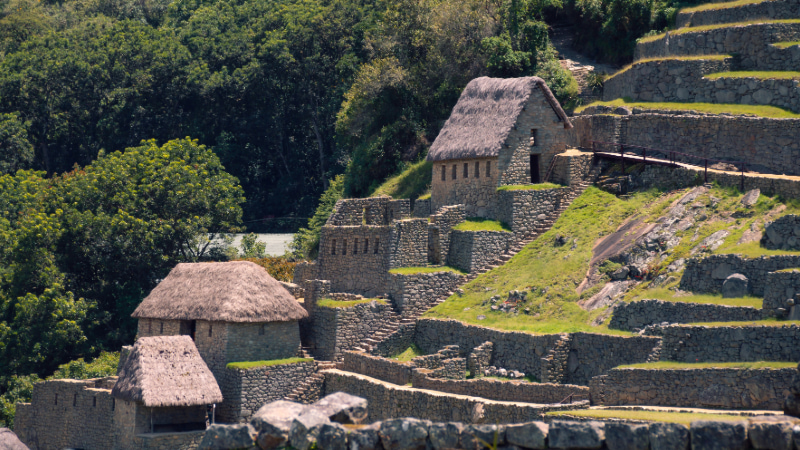
What Does Machu Picchu Mean?
In Quechua, Machu Picchu means “old mountain“. It is the name of the peak that rises south of the citadel, and it ended up naming the whole site. Across from it stands Huayna Picchu, meaning “young mountain“: the pointed peak behind the ruins in the classic photo.
The name the Incas themselves used for the citadel is not known for sure. In Quechua, still spoken across the Andes, “machu” means old and “picchu” translates as mountain or peak. You can climb Huayna Picchu, at about 2,700 m (8,860 ft), with a special ticket: we explain how in our Huayna Picchu guide.
Machu Picchu’s Sectors and Main Temples
The citadel is divided into two large sectors: the agricultural sector, with stepped terraces on the slopes, and the urban sector, home to the temples, plazas and buildings. These are the most important structures:
| Structure | Sector | Highlights |
|---|---|---|
| Terraces | Agricultural | Farming terraces that stabilize the mountain and help drain rainwater. |
| Temple of the Sun | Urban | Curved-wall building on a large rock, with windows believed to have been used to observe the sun. |
| Intihuatana | Urban | Carved rock on the high ground, linked by historians to rituals and to observing the sky. |
| Temple of the Three Windows | Urban | Stone wall with three large trapezoidal windows facing east. |
| Main Temple | Urban | Huge, finely fitted stone blocks beside the Sacred Plaza. |
| Sacred Plaza | Urban | Ceremonial space framed by the Main Temple and the Temple of the Three Windows. |
| Temple of the Condor | Urban | Natural rocks that recall the wings of a condor, a sacred bird in the Andes. |
Which buildings you see depends on the circuit on your ticket: not every route passes the same temples. We explain the circuits and how to choose in our guide to Machu Picchu tickets.
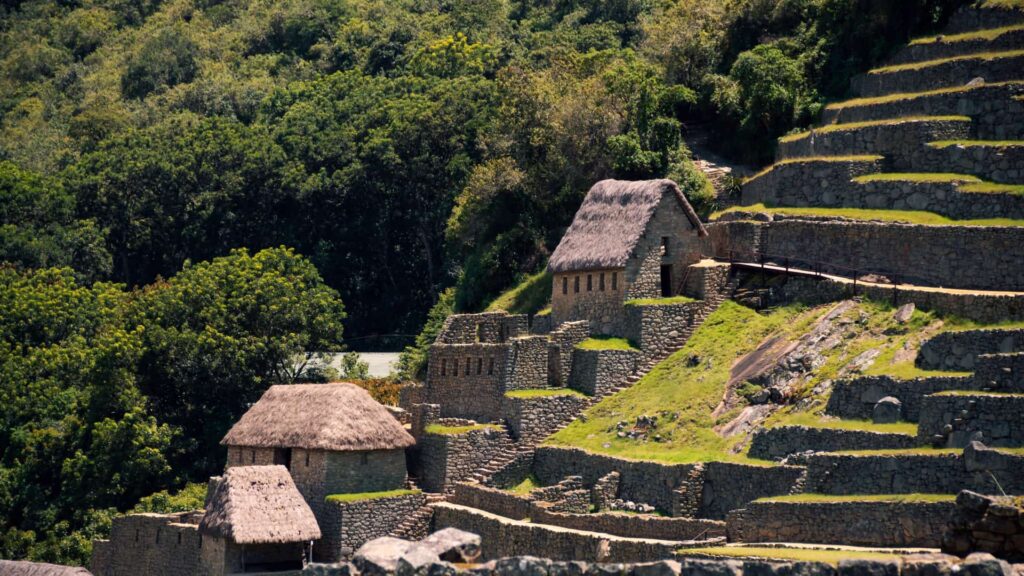
How Did the Incas Build Machu Picchu?
What amazes most travelers is how a citadel like this was raised on a mountain ridge. These are the keys to Inca engineering at Machu Picchu:
- Stone fitted without mortar: in the most important buildings, such as the Temple of the Sun and the Main Temple, the blocks were cut to fit together without mortar. Simpler buildings use rougher stone.
- Water channels: a system of channels and stone fountains carried water to different parts of the citadel.
- Terraces: besides being used for farming, the terraces support the slope and help control rainwater, which is essential in an area that gets heavy rain between November and March.
- Trapezoidal shapes: doorways, windows and niches narrower at the top than at the bottom, a hallmark of Inca architecture.
Much of the work at Machu Picchu cannot be seen: it lies underground, in the foundations and the drainage of the terraces. If this interests you, read our post on Inca economy, engineering and religion.
Machu Picchu history in five facts: it was built around the mid-15th century, in the time of Pachacuti; it served as a royal estate and religious center; it was abandoned around the conquest and the Spanish never found it; Hiram Bingham made it known in 1911, guided by local farmers; UNESCO declared it a World Heritage Site in 1983.
Machu Picchu Today: UNESCO Site and World Wonder
In 1983, UNESCO declared the Historic Sanctuary of Machu Picchu a World Heritage Site for both its cultural and natural value: it protects the citadel and also the mountain forests around it. In 2007 it was chosen as one of the New Seven Wonders of the World in a popular vote.
| When | What happened |
|---|---|
| Mid-15th century (approx.) | Built in the time of the Inca Pachacuti. |
| 16th century | Abandoned around the time of the Spanish conquest, without the Spanish ever finding it. |
| 1911 | Hiram Bingham brings it to the world’s attention, guided by local farmers. |
| 1983 | UNESCO declares it a World Heritage Site, cultural and natural. |
| 2007 | Chosen as one of the New Seven Wonders of the World. |
Today Machu Picchu is Peru’s best-known destination. To protect it, visits are made with timed tickets and along set circuits, so it pays to plan ahead, especially from May to October.
How to Experience Machu Picchu History in Person
The best way to understand Machu Picchu’s history is to walk through it with a guide who explains each temple on the spot. There are two main ways to get there:
- By train and bus: from Cusco or the Sacred Valley to Aguas Calientes, then by bus up to the citadel. We cover every option in our guide on how to get to Machu Picchu.
- On foot, along the Inca Trail: the route the Incas themselves used, with archaeological sites along the way. Read our guide to the Inca Trail to Machu Picchu.
Our 2-day Machu Picchu tour (from US$350) gives you time to explore the citadel without rushing. If you would rather arrive on foot, the 4-day Classic Inca Trail (from US$650) ends at the citadel after passing several Inca sites. Our guides speak English, Spanish and Portuguese, and every tour is booked with a 40% deposit online; you pay the balance when you arrive in Peru.
Machu Picchu History: Frequently Asked Questions
Who discovered Machu Picchu?
Hiram Bingham made it known to the world in 1911, but he was not the first to get there. Local farmers guided him to the site, and some families were already living and farming on its terraces.
How old is Machu Picchu?
More than five centuries old. It was built around the mid-15th century, in the time of Pachacuti. No exact date is documented.
Did the Spanish ever reach Machu Picchu?
They never found it. That is why the citadel was not looted or transformed in colonial times, and it is far better preserved than other Inca sites.
Why was Machu Picchu abandoned?
Nobody knows for certain. It was abandoned around the time of the Spanish conquest, and historians link it to the crisis of the Inca Empire, the state that supported the citadel.
What does Machu Picchu mean in Quechua?
It means “old mountain”. Huayna Picchu, the peak you see behind the citadel, means “young mountain”.
Can I visit Machu Picchu with a guide who explains its history?
Yes. On our Machu Picchu and Inca Trail tours you travel with local guides who speak English, Spanish and Portuguese. You book with a 40% deposit online and pay the balance when you arrive in Peru.
Walk Through Inca History at Machu Picchu
Machu Picchu sums up the best of the Inca world: a ruler who transformed an empire, engineering that still stands after more than five centuries and a sacred place the Spanish never found. Knowing its story before you go changes the whole visit.
For more background, read our introduction to Inca history. When you are ready, choose between the 2-day Machu Picchu tour and the Classic Inca Trail. Any questions? Contact us and we will help you plan your trip.


