English
 Español
 Português


The Maras salt mines are thousands of terraced salt pools on a mountainside near the village of Maras, in Cusco’s Sacred Valley. They were worked before the Incas, and local families still harvest salt there today. Most travelers visit them together with Moray, the circular Inca terraces, on a half-day trip from Cusco.
We are local guides based in Cusco, and we take travelers to Maras and Moray all year round. In this guide we explain how the salt is made, what Moray is, how to get there, which tickets you need and the best time to go.
What are the Maras salt mines?
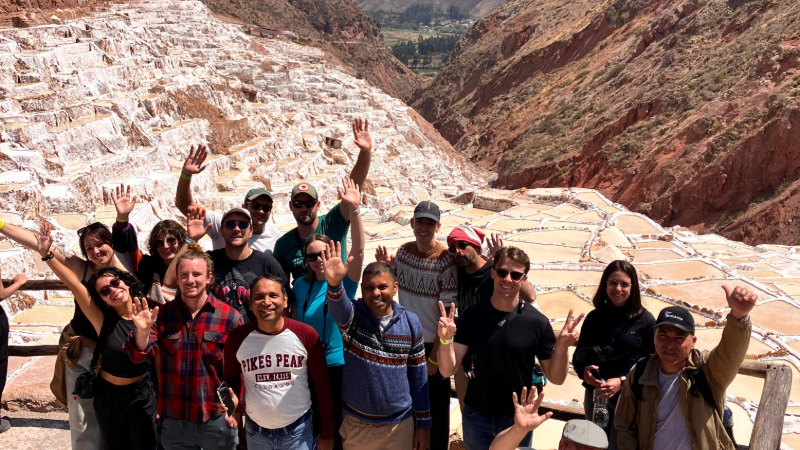
The Maras salt mines (in Spanish, Salineras de Maras) are a group of thousands of salt pools built in terraces on the slope of a hill. From the viewpoint above, they look like a mosaic of small white, cream and brown rectangles running down the ravine. It is one of the most photographed sights in the Sacred Valley.
This is not an archaeological site but a living workplace. The pools were in use before the Incas, and the technique has been passed down for centuries. Today they are worked by families from the local community, who inherit their pools from one generation to the next. When you visit, you see the salt workers using the same simple tools and the same rhythm as always.
At the entrance there are stalls where families sell pink salt and salt products. Buying there is a direct way to support the community, and a bag of salt is a light, easy souvenir to take home.
How is salt made at the Maras salt mines?
It all starts with a spring of very salty water that flows out at the top of the ravine. The water is channeled through small canals and fills the pools one by one. In short, the process works like this:
- Filling: each family lets the salty water into its pools.
- Evaporation: the Andean sun and wind slowly evaporate the water.
- Crystallization: once the water is gone, a layer of salt is left at the bottom of the pool.
- Harvest: the workers scrape the salt by hand, gather it and carry it off in sacks.
Because the process depends on the sun, salt is harvested mainly in the dry season. In the rainy months the water does not evaporate the same way and work slows down. That is why the color of the salt pools changes through the year: in the dry season white dominates, while in the rains the pools look darker.
What is Moray and what was it used for?
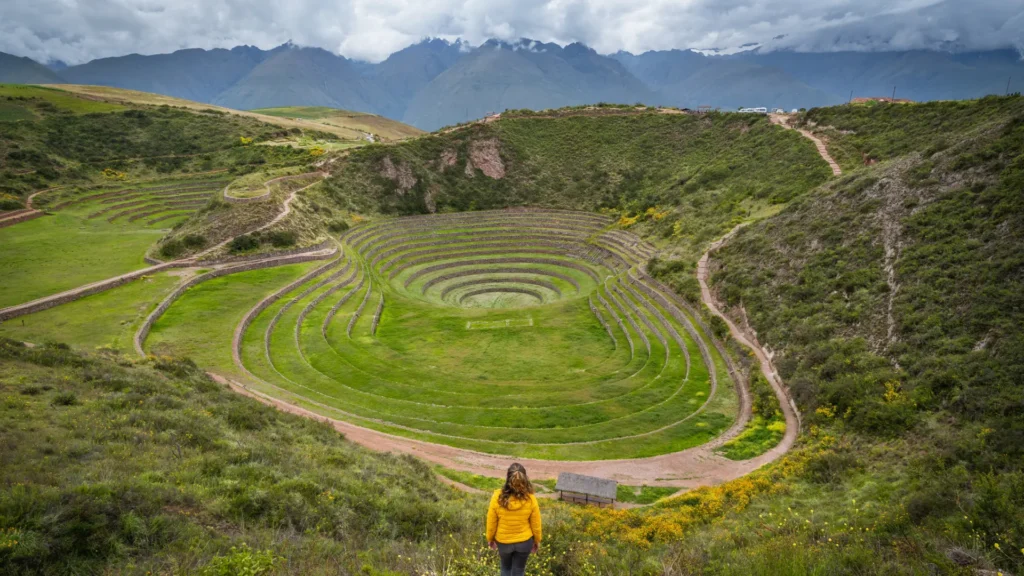
Moray is an Inca site made of concentric circular terraces, like a huge amphitheater carved into the earth. The terraces step down in rings to a flat bottom, and the view from the rim is one of the most unusual in the Cusco region.
It is believed to have been an Inca agricultural research center. The idea is that each level has its own microclimate: sun, wind and temperature are not the same at the top as at the bottom. This would have allowed the Incas to test crops in different conditions in a single place. Your guide explains this theory on site, but keep in mind it is an interpretation: the Incas left no written records to confirm it.
Moray sits at about 3,500 m (11,500 ft), slightly higher than the city of Cusco. The visit is easy, with short walks on the paths around the terraces. If you have just arrived, walk slowly and drink water. Our Cusco elevation guide has an altitude chart for the main destinations.
Where are the Maras salt mines and Moray, and how do you get there from Cusco?
Both sites are in the Cusco region, in the Sacred Valley area, near the village of Maras. From Cusco the road crosses the Chinchero plateau, a high plain of farm fields with views of snow-capped peaks. Moray lies up on the plateau, while the salt pools sit in a ravine that drops toward the Urubamba River.
The easiest way to go is on a tour, because the two sites are some distance apart and the tour takes care of transport between them. With a tour you see both in half a day, with transport and a guide. If you want to see the rest of the valley, our Sacred Valley guide will help you plan it.
How to visit Maras and Moray: half day or Sacred Valley VIP
We offer two ways to see Maras and Moray. This table will help you choose:
| Maras and Moray (half day) | Sacred Valley VIP (full day) | |
|---|---|---|
| Price | US$30 | US$90 |
| Length | Half day | Full day |
| What you see | Moray and the Maras salt mines | Pisac, Ollantaytambo, Moray and the Maras salt mines |
| Entrance fees | Not included: paid separately | Moray and Maras entrance fees included |
| Lunch | Not included | Included |
| Schedule | Morning and afternoon departures | All day |
| Best for | Travelers with half a day free in Cusco | Travelers who want the highlights of the valley in one day |
Our Maras Moray tour costs US$30 per person and includes hotel pickup, transport and a guide in English, Spanish or Portuguese. There are morning and afternoon departures, and the guide decides the order of the visit based on the weather that day. Entrance fees are paid separately.
If you prefer a full day, the Sacred Valley VIP tour (US$90) includes the entrance fees to Moray and Maras, plus Pisac and Ollantaytambo, with lunch. It is the best choice if you have no other day for the valley.
Book with 40%: our Maras and Moray and Sacred Valley tours are booked by paying only 40% online. You pay the balance when you arrive in Peru.
Maras and Moray entrance fees
The two sites have different tickets, so it helps to know this before you leave Cusco:
- Moray: entry is with the Cusco Tourist Ticket (Boleto Turístico del Cusco), the same ticket used at Sacsayhuamán and other sites in Cusco and the Sacred Valley. If you already have one, bring it. We explain how it works in our Coricancha and Sacsayhuamán guide.
- Maras salt mines: they have a separate entrance fee that is not part of the Tourist Ticket. It is paid on site, in Peruvian soles.
We don’t list prices because they change. Bring soles in cash for the salt mines entrance and for buying salt. On the half-day Maras and Moray tour, both entrance fees are on you; on the Sacred Valley VIP tour, they are already included.
Best time to visit Maras and Moray
The best time is the dry season, roughly from April to October. Skies are clear, paths are dry and families are harvesting salt, so the salt pools look white and busy.
In the rainy season, roughly from December to March, the landscape turns green and there are fewer visitors, but the salt mines visit may change or even close because of the weather. If that happens on the day of your tour, we will let you know. Moray can be visited all year. For month-by-month weather, see our guide to the best time to visit Cusco.
As for the time of day, morning departures often have clearer skies. In the afternoon the light is warmer for photos, but in the Andes it sometimes clouds over or gets windier. That is why the guide adjusts the order of the visit to the weather.
What to bring to Maras and Moray
- Soles in cash: for the salt mines entrance and for buying salt.
- Cusco Tourist Ticket: if you already have one, to enter Moray.
- Sun protection: sunscreen, sunglasses and a hat. The high-altitude sun burns fast, and at the salt mines the white salt reflects it.
- A light jacket: the Chinchero plateau is windy and mornings are cool.
- Comfortable shoes with good grip: the paths at the salt mines are narrow and can be slippery or muddy.
- Water and a snack: especially on the half-day tour, which does not include meals.
- Rain poncho: if you travel between December and March.
A tip from your guide: at the salt mines, stay on the marked paths and don’t step on the edges of the pools. They are the work and livelihood of the families. And if you are curious about the local cuisine, read our guide to Andean food.
Frequently asked questions
How much time do you need to visit Maras and Moray?
Half a day is enough to see both sites from Cusco, including travel. If you want to add Pisac and Ollantaytambo, you need a full day, as on the Sacred Valley VIP tour.
Does the Cusco Tourist Ticket include the Maras salt mines?
No. The Tourist Ticket covers Moray, but the salt mines have a separate entrance fee, paid on site in soles.
Are the salt mines open in the rainy season?
Usually yes, but roughly from December to March the visit may change or close because of the weather. If the salt mines are closed on the day of your tour, we will let you know.
Is the Maras and Moray visit difficult?
No. The walks are short, without big climbs. Moray is at about 3,500 m (11,500 ft), so take it slowly if you have just arrived in Cusco. Read our tips on altitude sickness in Peru.
Can you buy Maras salt?
Yes. Pink salt and salt products are sold at the entrance to the salt mines. Bring soles in cash.
How much do your Maras and Moray tours cost?
The half-day tour costs US$30, without entrance fees. The Sacred Valley VIP tour costs US$90 and includes the Moray and Maras entrance fees. Both are booked with 40% online, and you pay the balance when you arrive in Peru.
Plan your visit to Maras and Moray
The Maras salt mines and Moray show two sides of the Andean world: a working tradition that is still alive and an Inca site that still holds unanswered questions. Go in the dry season if you can, bring soles in cash and protect yourself from the sun.
If you have a free morning or afternoon in Cusco, book our half-day tour to Maras and Moray. If you would rather combine it with Pisac and Ollantaytambo, choose the Sacred Valley VIP. On both you pay only 40% online and the rest when you arrive in Peru. Questions? Write to us and we will get back to you.