English
 Español
 Português


Vinicunca history goes far beyond its famous stripes. For the Quechua communities of Pitumarca, in the Canchis province of Cusco, the Rainbow Mountain is a sacred place watched over by the apus, the guardian spirits of the Andes, and above all by Apu Ausangate. Here we explain its origins, its meaning and the legends around it.

Vinicunca history: from ancient sediments to world fame
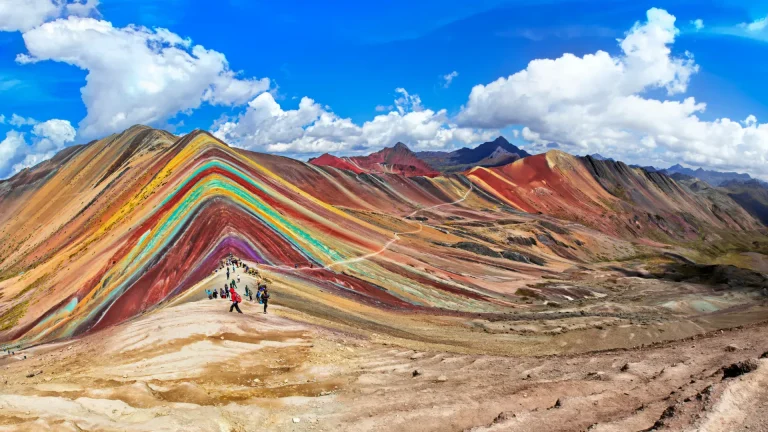
Vinicunca, also known as the Mountain of Seven Colors, rises to about 5,200 meters in the district of Pitumarca, province of Canchis, in the Vilcanota mountain range southeast of Cusco. Its colors are the work of geology: layers of sediment rich in different minerals were deposited, compressed and tilted over millions of years, and erosion later exposed them as bands of red, ochre, yellow, green and lilac.
For generations, these slopes were simply part of the pastures of Quechua herders who raise alpacas and llamas at high altitude. The mountain was known locally, but it only became famous worldwide recently, when photos of its striped ridge began to circulate and visitors started to arrive from all over the world. That sudden fame changed the economy of the surrounding communities, which today organize access to the mountain and offer services to travelers.
Who are the apus that protect Vinicunca?
In the Andean worldview, the great mountains are apus: powerful beings that protect the people, the animals and the water that flows down from their slopes. They are respected together with the Pachamama, Mother Earth. According to the local communities, Vinicunca is protected by these guardian spirits, and the stories say that the apus can show themselves as shadows, sudden breezes or even dreams to those who walk the mountain with humility and respect.
Apu Ausangate, the great guardian of the region
The most important apu of this area is Ausangate, a snow-capped peak of more than 6,000 meters that dominates the horizon near Vinicunca. It is considered one of the most powerful mountains in southern Peru. At its foot, in the Sinakara valley, thousands of pilgrims gather every year for Qoyllur Rit’i, a festival that is held in the weeks before Corpus Christi and that mixes Catholic devotion with the ancient worship of the mountains. To learn more about this mountain, read our guide to Ausangate.
Offerings to the mountain
Local families still make offerings to the apus and the Pachamama to ask for good pastures, healthy animals and safe journeys. The best known is the “pago a la tierra” or despacho, a bundle of coca leaves, seeds, sweets and other symbolic items. It is not part of our tours, but we can add one on request. Along the trails you will also see apachetas, small piles of stones that travelers add to as a sign of gratitude when they reach a pass.
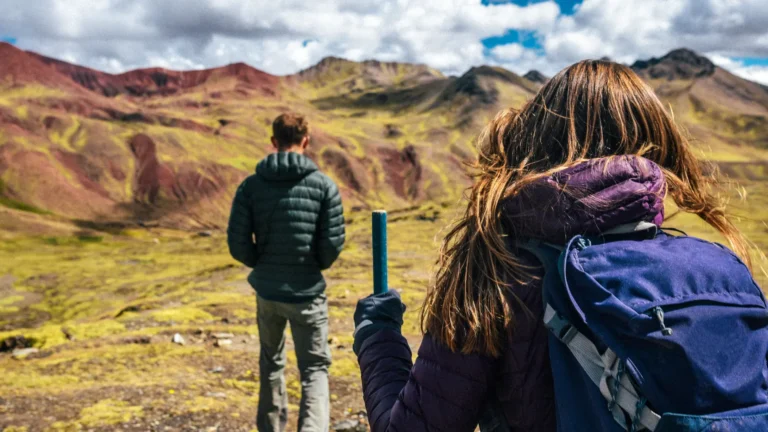
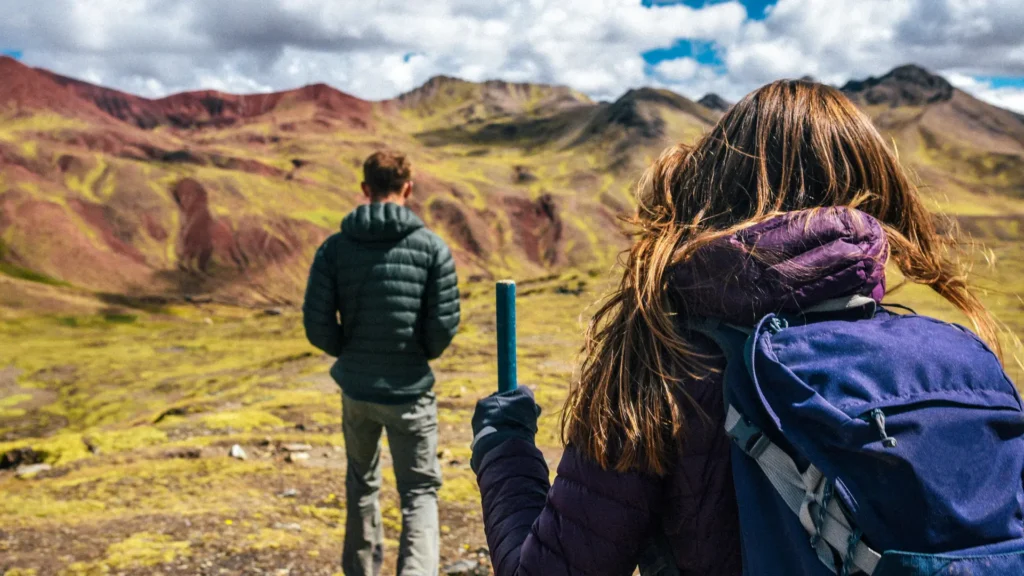
Our advice: before you visit Vinicunca, spend a few days acclimatizing in Cusco and bring warm clothing and good footwear. On the mountain, stay on the marked paths, do not take stones and ask before photographing local people: it is the simplest way to show respect for the apus and for the communities who care for them.
Why is Vinicunca important for local communities today?
Vinicunca’s history is still being written by the people who live around it. Herding continues to be the base of local life, and textiles woven with alpaca wool keep designs passed down from mother to daughter. Tourism has added new income through horse services, food and handicrafts, and it has also opened debates about how to protect the fragile landscape. Hiring a local guide helps you understand these stories and supports the families of the area. If you want to see it in person, our Rainbow Mountain tour from Cusco includes the hike and the explanations of a guide from the region.
Vinicunca: key facts. Here is a summary of what you have just read about the Rainbow Mountain:
| Fact | Details |
|---|---|
| Other names | Mountain of Seven Colors, or Rainbow Mountain. |
| Altitude | About 5,200 m (17,060 ft). |
| Location | Pitumarca district, Canchis province, in the Vilcanota mountain range southeast of Cusco. |
| Guardian apus | For the Quechua communities, the mountain is protected by the apus, above all Apu Ausangate, a snow-capped peak of more than 6,000 m (19,685 ft) that dominates the horizon near Vinicunca. Learn more in our guide to Ausangate. |
| Origin of the colors | Geology: layers of sediment rich in different minerals were deposited, compressed and tilted over millions of years, and erosion later exposed them as bands of red, ochre, yellow, green and lilac. |
| How it became famous | Its slopes were pastures for Quechua herders of alpacas and llamas. The mountain was known locally, but it only became famous worldwide recently, when photos of its striped ridge began to circulate. Today the surrounding communities organize access and offer services to travelers. |
| Tour | Rainbow Mountain tour from Cusco (1 day, US$50), with the hike and the explanations of a guide from the region. |
Other sacred places around Cusco and their legends
Vinicunca is not the only place where nature and spirituality come together. These are other sites in the Cusco region with their own oral traditions.
Palcoyo, the quiet sister of Vinicunca
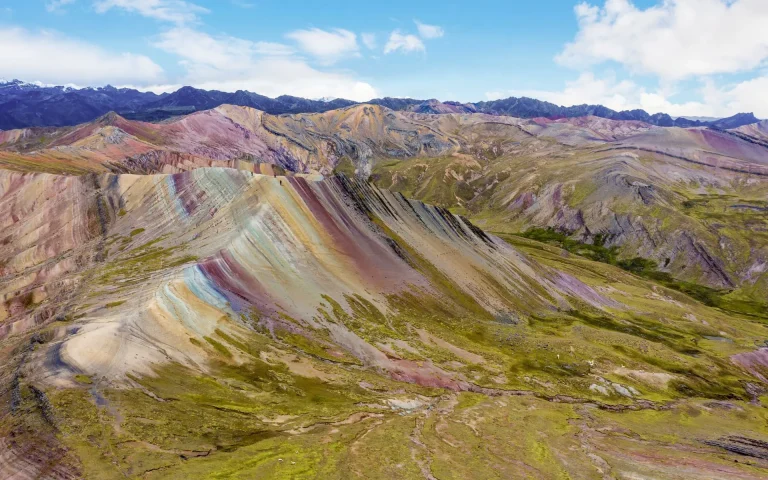
Palcoyo (also written Palccoyo) is another multicolored mountain, less famous and less crowded. Local communities speak of a special bond between these mountains and the stars, and say that the sky influences the colors and the energy of the place. Visitors often describe it as a calmer, more contemplative experience, with a shorter walk.
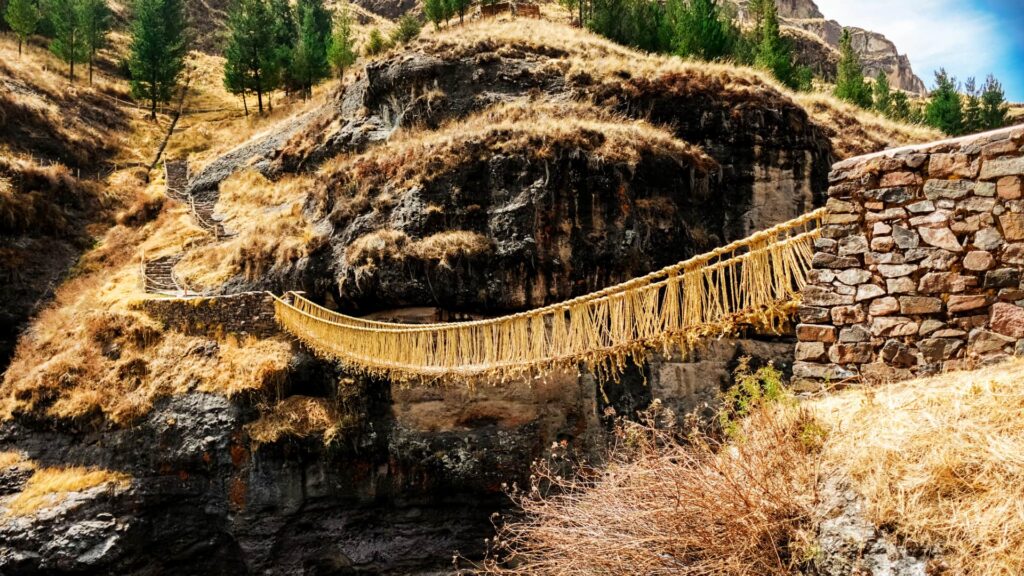
Q’eswachaka, the bridge between two worlds
The Q’eswachaka bridge is an Inca suspension bridge made entirely of plant fibers. It has survived thanks to the communities that rebuild it every year in June, a tradition recognized by UNESCO as Intangible Cultural Heritage. For local people it connects not only the two sides of the canyon but also the earthly and the spiritual world, and they speak of an invisible guardian that protects those who cross with respect. If you are in Cusco at that time, the renewal ceremony is well worth seeing.
Humantay Lake, enchanted waters
Below the glaciers of the Salkantay range, the turquoise Humantay lagoon is surrounded by legends. It is said to have healing and spiritual powers, and that those who approach its waters with respect can hear whispers or see reflections of figures and lights that vanish in an instant. The hike is short but steep, so bring water and warm clothes. You can visit it on our Humantay Lake tour.

Urcos Lagoon, a mirror of the past
The small Urcos lagoon, southeast of Cusco, has its own legend: oral tradition says that whoever looks into its waters at dawn can glimpse scenes of the Inca past, such as ceremonies or processions, as if the lagoon kept a spiritual memory of its surroundings. Some stories also mention strange creatures, even mermaids. It is a quiet place to slow down and enjoy the landscape.

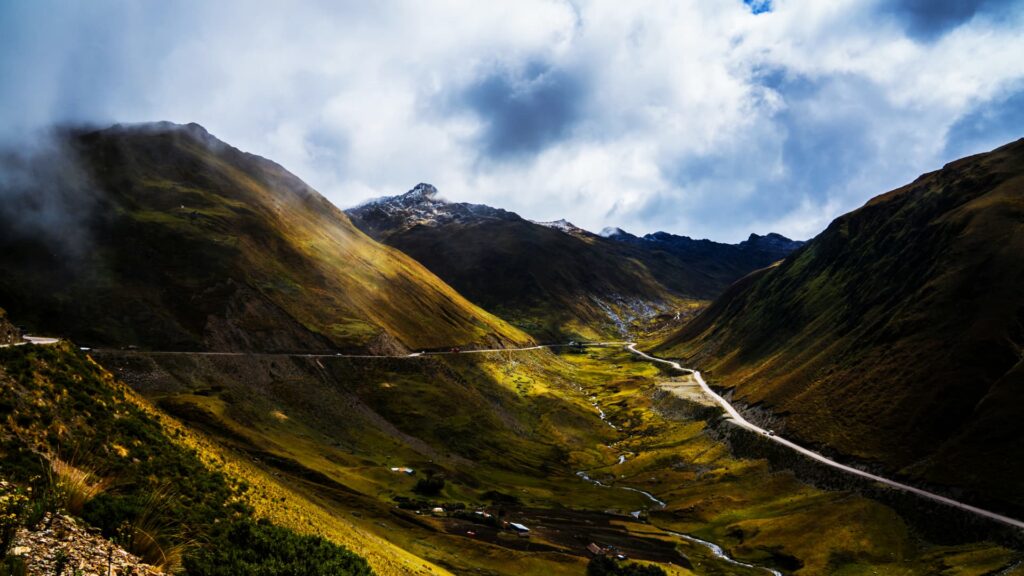
Abra de Málaga, a portal between worlds
Abra de Málaga is the high mountain pass that links the Sacred Valley with the jungle of La Convención. Local stories describe it as a portal between the earthly and spiritual worlds, and some travelers tell of sudden weather changes, a strong sense of déjà vu or figures that disappear in the blink of an eye. It is popular with cyclists and hikers; bring layers, because the weather changes quickly.
Discover Vinicunca with a local guide
Knowing the history of Vinicunca and the role of its apus turns a demanding hike into a meeting with a living culture. If you would like to walk to the Rainbow Mountain with guides from Cusco who share these stories, take a look at our Vinicunca Rainbow Mountain tour or contact us to plan your trip. If you would also like to get close to Apu Ausangate, our one-day tour to the 7 Lakes of Ausangate climbs to about 4,850 m.